One of our Brazilian students, Tiago, sent me a video clip from Haiti. It was shot by a Brazilian U.N. peacekeeper soldier moments after the 7.0 magnitude quake struck Port-au-Prince a week ago. While I can’t understand the Portuguese voiceover or subtitles, the footage reality transcends all languages. Cement rubble lies strewn in the city street, a thick cloud of dust hovers above the surreal scene, while survivors stumble in a daze, in silence or with tears and screams. As the peacekeeper walks through the mayhem, filming as he proceeds, suddenly into view there is a cathedral, its façade crumbled across the street. But amazingly a giant porcelain crucifix towers toward the sky amidst the strewn debris. Some are gathered on their knees before the hanging Christ, with arms outstretched toward him, pleading in voices loud enough to be heard on the video. And you don’t have to speak Creole to know the content of their prayers. It is a scene you will not quickly forget.(http://fantastico.globo.com/Jornalismo/FANT/0,,MUL1451469-15605,00-VIDEO+MOSTRA+PRIMEIROS+MOMENTOS+DA+TRAGEDIA+NO+HAITI.html)
Where was Christ on that day and these now ten days hence of incomprehensible tragedy and mounting human loss? Is he a porcelain God, unmoved by suffering, even of this magnitude?
The ancient prophet quietly confessed, “In all their affliction, he was afflicted” (Isaiah 63:9). In all our affliction, God is afflicted? It is true—the Eternal One, who emerges from amidst the narratives and nuances of Holy Scripture, is often times perceived by our distressed hearts as deus absconditus, what Martin Luther called “the hidden God.” And those sobbing prayers at the foot of that porcelain crucifix no doubt were directed in their anguish at the “hidden God”—the incomprehensible One who in our suffering can seem so very far away.
But the irony of that dust-choking scene from Haiti is that it portrays a more compelling truth: it is in the midst of our desperate human pain that the cross still towers with hope. For in the face of its Victim, we gaze upon the face of God—the only God in the universe who has entered into our human tragedy and in our affliction continues to be afflicted. How can we know? Because the cross is his own multiple-magnitude sacrifice to purchase the right to one day obliterate evil’s dark and tyrannical rule in Haiti and here. “Then shall be brought to pass the saying that is written, Death is swallowed up in victory” (I Corinthians 15:54).
But until then, in all our affliction, he is afflicted. Or in the words of William Blake, “Till our grief is fled and gone, He doth sit by us and moan.”
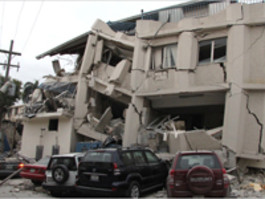
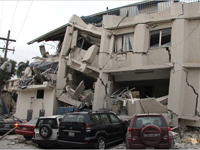 Haiti’s devastating earthquake on Tuesday afternoon is our crisis, too. As I sit here and write the next morning, initial reports from Port-au-Prince indicate that much of the capital city of nearly 1.5 million residents lies buried beneath collapsed rubble, as the result of the 7.0 magnitude record-breaking temblor. The Parliament building, the presidential palace, the United Nations mission headquarters, hospitals, schools, churches and untold numbers of apartments, houses and tenement buildings have been flattened. How many lives have been lost in this epic disaster no one, of course, yet knows. Some already fear untold thousands of casualties.
 Do you really think new “pat down” measures at the airport will make air travel more secure? I read a piece by syndicated British columnist Gwynne Dyer, and I’m afraid he’s right. In response to the Christmas Day attempt to bring down that Detroit-bound airliner through concealed explosives on one of the passengers, government officials have had to devise some sort of official “upgrade” to our present travel security to assure the traveling public that the skies once again are “friendly.” Dyer comments, “It is the duty of all public officials to ‘do something’ whenever a new threat appears, even if there is nothing sensible to be done.” The truth is that profiling international travelers by nationality or country of birth or origin (as the new security regulations do) not only lumps vast numbers of innocent people into the category of “suspicious” (or, guilty until proven innocent), it assumes that terror and terrorists are limited to these watch-listed nations (which is hardly true). And as for hand searches, most agree that the only effective method of full-body screening would need to include “body cavity searches.” And the public will not stand for that, will we?
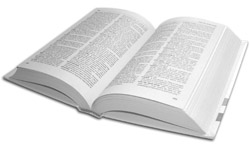 Poor Jesse Sheidlower, editor at large of the Oxford English Dictionary—he can’t even show up at a holiday party without being cornered by another distraught denizen of the English-speaking world with the query, “What are we supposed to call the decade that’s now ended?” Pretend you’re the editor of the dictionary—how would you answer all those emails? After all, we call the 80’s the 80’s and the 90’s the 90’s. But what shall we call the 00’s? The Zeroes? Hardly. How about the Aughts (English for the number 0)? Or the Ohs? Or the Oh-Ohs (I like that one!)?
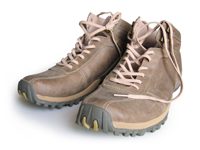 “I complained to God that I had no shoes, until I met a man who had no feet.” That dusty line from Thanksgivings past finds fresh meaning in Derek McGinnis’ new book, Exit Wounds: A Survival Guide to Pain Management for Returning Veterans and Their Families. November 9, 2004, Navy corpsman McGinnis was in Fallujah, Iraq, racing in an ambulance to pick up injured Marines, when a Mercedes Benz packed with homemade explosives crashed into his side of the ambulance, severing his left leg above the knee and exploding shrapnel into one eye. After years of rehabilitation at Bethesda Naval Hospital, Walter Reed Army Medical Center, and the Palo Alto Veterans Hospital, 32-year-old husband and father Derek is focusing his life now on assisting other veterans and families who are having to pick up the pieces and cobble together a life beyond the war. A consultant with the American Pain Foundation, he is spreading a message of hope beyond adversity. “It’s OK to have mental pain, it’s OK to have physical pain. There are methods to have a productive life” (SBTribune 11-18-09). The proof hangs in the McGinnis garage at home—the racing bibs of a long distance runner: the 2006 Marine Corps Marathon, the 2006 Army 10-Miler, and the 2007 Alcatraz Challenge. All of the races run with a flexible prosthetic left leg replete with a neatly-laced running shoe at the end of the metal post. Derek McGinnis is grateful to be running at all.
 Amen to AMEN! Karen and I had the privilege of joining several hundred physicians and dentists and their families this past weekend in Gatlinburg, Tennessee. You should’ve heard their stories. Here they are—medical professionals in the thick of their careers across this nation—pursuing Christ in the marketplace of health care. Or, as dentist Dusong Kim described it, it was Christ in hot pursuit of him, as the Cessna twin engine he was piloting in the dark over an invisible patch of California below, dropped out of the night sky, its engines shut down. Clutching the stick in desperation, his mind racing, his wife and two small children strapped in beside and behind him, this dentist at the apex of a lucrative practice recounted those life-altering moments as he blindly crashed the craft into an orchard of almond trees. But out of that survival, his testimony described a redirected career, ignited by a new passion for God and his mission. Or there was young orthopedic resident Joshua Drumm, who discovered that his lifelong ambition to become an orthopedic surgeon was tanking, simply because he refused to attend the residency application interview on Sabbath. The drama of his pleading before God, the subsequent rejections from elite orthopedic residencies across the nation once his Sabbath conviction became known, his refusal to compromise his commitment to his Creator, the Philadelphia hospital orthopedic chief’s repeated attempts to persuade Joshua otherwise—his was a shining testimony of trust in God for all of us who listened, medical professionals or not. Today Dr. Kim and his family are missionaries in Bolivia. And Dr. Drumm and his wife are in a successful orthopedic residency in Philadephia. “Faith in practice”—the weekend theme for this retreat—is more than evident in the lives of these many medical professionals. And on this campus of over 3500 young adults, how many of them, how many of you, will also hear the call of Christ to follow him as a medical missionary? Perhaps not to some foreign shore, but nevertheless you are being called to be a missionary for the kingdom right here at home in this nation. Massive student loans, society’s drumbeat to reflect the affluence accorded your medical station in life—there will be myriad pressures to turn a practice into a lucrative career. But I was impressed with this hotel ballroom full of medical professionals who have chosen to reject societal norms and instead plunge into a self-sacrificing life of healing our broken world in the name of Jesus. You can be one of them one day. Why the name AMEN? Because it stands for Adventist Medical Evangelists Network. Doctors, dentists, health care professionals as evangelists? Why the surprise? After all, God had only one Son—and he called him to be a medical evangelist. Could you be in better company?
 “20 reasons America has lost its soul and collapse is inevitable.” Not exactly the sort of headline that CBS’s staid economic website, MarketWatch.com, is used to running. In a sobering, columnist Paul B. Farrell opens with the pronouncement, "We've lost 'America’s soul.' And worldwide, the consequences will be catastrophic." He suggests it’s a gut sense we all have: "You know something’s very wrong: A year ago, too-greedy-to-fail banks were insolvent, in a near-death experience. Now magically, they're back to business as usual, arrogant, pocketing outrageous bonuses while Main Street sacrifices, and unemployment and foreclosures continue rising as tight credit, inflation and skyrocketing federal debt are killing taxpayers." His indictment of Wall Street is biting. It "has lost its moral compass." Farrell outlines twenty top reasons why he believes American capitalism is doomed—from the life cycle of empires to today’s financial disparity (where "America’s top 1% own more than 90% of America’s wealth") to the explosion of the federal debt from $11.2 to $23.7 trillion. He concludes, “The coming collapse [with a “high probability by 2012”] is the end of an ‘inevitable’ historical cycle stalking all great empires to their graves. Downsize your lifestyle expectations, trust no one, not even media. . . . [T]here’s absolutely nothing you can do to hide from this unfolding reality or prevent the rush of the historical imperative.”